Digital menu boards have evolved far beyond replacing printed menu panels with LCD screens.
For restaurant chains, the modern digital menu board is now a technology stack connecting commercial displays, media players, content management, menu and pricing data, POS systems, restaurant operations, monitoring and field service.
Canopee Tech is an interesting new entrant because it approaches that stack specifically from the restaurant side.
Founded by longtime restaurant technology executive Thibaud Denolle, Canopee provides an end-to-end digital menu board platform encompassing software, hardware, deployment, monitoring and ongoing support.
The company reported in August 2026 that just four months after its first pilot it had exceeded 1,500 restaurant locations and 10,000 displays across four major global restaurant chains.
Those numbers make Canopee worth examining not simply as another digital signage CMS, but as part of a changing digital menu board technology landscape.
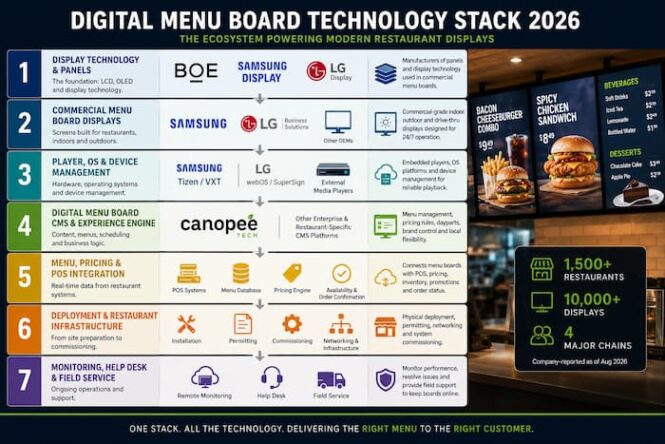
The Digital Menu Board Technology Stack
One of the challenges in evaluating menu-board suppliers is that companies operating in very different parts of the technology chain are frequently placed in the same category.
Samsung, LG, BOE and Canopee all participate in digital menu boards, for example, but they do not necessarily compete at the same level.
Layer 1 — Display Technology & Panels
BOE | Samsung Display | LG Display
Everything ultimately begins with the display.
Companies at this level manufacture the LCD, OLED and other display technologies that become commercial signage products.
BOE is particularly important at this layer. Its commercial digital signage portfolio includes displays from 32 to 110 inches, 24/7 operation, outdoor operating-temperature options and specialized display formats. BOE specifically identifies retail and catering among the applications for its signage products.
This is the manufacturing foundation of the menu-board ecosystem.
Layer 2 — Commercial Menu Board Displays
Samsung | LG | Commercial Display OEMs
At this level, display technology becomes a deployable restaurant product.
Samsung and LG are two of the most visible global suppliers.
Samsung markets indoor digital menu boards, outdoor QSR displays, drive-thru displays and order-status boards.
LG similarly offers indoor menu boards, high-brightness and outdoor displays, ultra-stretch signage, LED and drive-thru display solutions.
For restaurant operators, the important distinction is commercial duty cycle. Menu boards may operate 18–24 hours per day and outdoor drive-thru systems must deal with sunlight, temperature extremes, weather and continuous operation.
Layer 3 — Player, Operating System & Device Management
Samsung Tizen/VXT | LG webOS/SuperSign | External Media Players
Historically, a digital menu board usually required a screen plus a separate media player.
That distinction is becoming less clear.
Commercial displays from Samsung and LG increasingly incorporate system-on-chip processing and signage operating platforms directly into the display.
Samsung extends this through VXT, its cloud-native CMS and device-management platform.
LG’s webOS signage platform similarly provides integrated playback and management capabilities, while SuperSign adds content creation, distribution and device management.
Third-party media players remain important, particularly where restaurant operators want hardware independence or specialized edge-processing capabilities.
Layer 4 — Digital Menu Board CMS & Experience Engine
Canopee | Enterprise Signage CMS | Restaurant-Specific Platforms
This is where the restaurant experience starts becoming more important than the screen.
A generic CMS can schedule an image of a hamburger.
A restaurant digital menu board platform needs to understand considerably more.
Menus can change according to:
- Daypart
- Restaurant
- Region
- Franchisee
- Product availability
- Pricing
- Promotion
- Store format
- Drive-thru lane
- POS data
- Corporate campaign
Canopee calls its software layer the Experience Engine.
The company emphasizes giving restaurant marketing teams direct control while maintaining corporate brand standards and allowing controlled local flexibility.
This is one of the important dividing lines between digital signage and a true restaurant digital menu board platform.
Layer 5 — Menu, Pricing & POS Integration
POS | Menu Database | Pricing | Availability | Order Confirmation
The next layer connects what customers see with what the restaurant can actually sell.
A modern menu board may need to know:
- Current price
- Product availability
- Restaurant location
- Daypart
- Promotion eligibility
- Menu configuration
- POS data
- Order status
Canopee lists real-time pricing and order confirmation among its platform capabilities.
Interestingly, the display manufacturers are also moving into this layer. Samsung VXT, for example, offers POS-integrated menu-board functionality capable of automatically updating menu items and prices.
This illustrates how the traditional boundaries between hardware, CMS and restaurant software are beginning to overlap.
Layer 6 — Deployment & Restaurant Infrastructure
Installation | Permitting | Commissioning | Networking | Outdoor Infrastructure
Enterprise menu-board deployment becomes a physical infrastructure project.
Someone must install the displays, provide power and connectivity, commission the system and—in outdoor drive-thru applications—potentially handle permitting and specialized structures.
Canopee includes permitting, installation and commissioning as part of its offering.
This gives it a different business model from a software-only CMS supplier.
Layer 7 — Monitoring, Helpdesk & Field Service
Remote Monitoring | Device Health | Helpdesk | Field Service
A blank menu board at 12:15 p.m. is not simply a signage problem.
It can become a restaurant operations problem.
Enterprise deployments therefore require remote monitoring, diagnostics, escalation and ultimately field service.
Canopee includes helpdesk, monitoring and field support in its end-to-end model.
Samsung and LG also provide device-management capabilities at the display/platform level.
Menu Board Market Landscape
| Layer | Representative Companies | Primary Role |
|---|---|---|
| Display technology | BOE, Samsung Display, LG Display | Panels and underlying display technology |
| Commercial displays | Samsung, LG and commercial display OEMs | Indoor, outdoor and drive-thru screens |
| Player / OS | Samsung Tizen, LG webOS, third-party players | Playback and device computing |
| CMS / menu platform | Canopee and enterprise signage platforms | Content, menus, scheduling and business rules |
| Restaurant integration | POS and restaurant software providers | Pricing, menu, availability and transaction data |
| Deployment | Canopee, integrators and installation partners | Installation, permitting and commissioning |
| Operations | Canopee, OEMs and service organizations | Monitoring, helpdesk and field service |
The key point is that there is no single “menu board company” category anymore.
Companies can participate in one layer or several.
Samsung and LG Are Moving Down the Stack
Samsung and LG deserve special attention because they no longer fit neatly into the category of display manufacturers.
Samsung can provide commercial displays, embedded processing, device management, VXT CMS and POS-integrated menu-board functionality.
LG combines commercial displays with webOS and its SuperSign content-management ecosystem. LG specifically markets centralized menu and price updates for QSR deployments.
Both companies therefore extend from the physical display into software and management.
That potentially reduces the number of vendors required for a straightforward menu-board deployment.
But large restaurant chains often have requirements that extend well beyond displaying and scheduling content.
That is where restaurant-specialized platforms become relevant.
Where Canopee Fits
Canopee effectively enters the stack from the opposite direction.
Samsung and LG start with the display and move toward software.
Canopee starts with the restaurant experience and menu operation and moves outward to encompass hardware, deployment and support.
That distinction helps explain Canopee’s positioning.
The company describes its platform around:
- Complex menu logic
- Brand control
- Local restaurant flexibility
- Real-time pricing
- Order confirmation
- Enterprise scalability
- Cached local playback
- Security
- Indoor and outdoor hardware
- Installation
- Monitoring
- Field support
Rather than asking simply, “Which CMS should run our screens?”, Canopee is positioning the decision more broadly:
“How should the restaurant’s entire digital menu board environment operate?”
Founder Brings Long QSR Experience
Although Canopee itself is young, founder Thibaud Denolle is not new to restaurant technology.
Denolle spent approximately 12 years with Acrelec, where his roles included Innovation & Marketing Director and extensive involvement with restaurant technology, digital menu boards, drive-thru systems and customer-experience technology.
That experience is particularly relevant because Acrelec has worked with some of the world’s largest QSR brands.
Canopee therefore enters the market with practical exposure to the problems that emerge when restaurant technology moves from a pilot into hundreds or thousands of locations.
Early Scale: 10,000+ Displays
Canopee reported in August 2026 that it had passed:
1,500+ restaurants
10,000+ displays
4 major global restaurant chains
Approximately four months since its first pilot
The customer identities have not all been publicly disclosed, and the deployment figures are company-reported.
Even with that qualification, the rollout velocity is significant.
Enterprise menu-board deployments involve far more than shipping screens. Menu configuration, content migration, installation, networking, restaurant-level exceptions, pricing, monitoring and support all become more difficult as the location count increases.
Reaching four-digit store counts provides an important early test of the underlying architecture.
Why the Market Is Changing
The next generation of menu boards will increasingly be driven by data rather than playlists.
Traditional digital signage asks:
What content should play on this screen?
Restaurant systems increasingly need to ask:
What products should this restaurant offer, at what price, at this time, in this location, based on current operating conditions?
That is a fundamentally different problem.
It also means POS systems, menu databases, pricing engines, inventory systems, loyalty platforms, AI and restaurant operations will increasingly influence what appears on the menu board.
The screen is becoming the final presentation layer of a much larger restaurant technology system.
TIG Perspective
The digital menu board market is becoming a stack rather than a product category.
At one end are companies such as BOE, supplying the underlying display technology.
Samsung and LG turn display technology into commercial restaurant products and increasingly extend into embedded computing, content management and device management.
At another level are restaurant-focused platforms such as Canopee, where the primary problem is no longer how to put content on a screen but how to manage menus, prices, brand standards and restaurant-level variation across potentially thousands of locations.
Then come POS, menu-data and restaurant-management systems that supply the operational information behind the menu.
The competitive lines will continue to blur.
Display manufacturers will move further into software. CMS providers will add restaurant integrations. Restaurant technology companies will package hardware and field services. AI will introduce another decision layer between restaurant data and what the customer sees.
For restaurant operators, the important question therefore isn’t simply “Who makes the menu board?”
It is:
“Who controls each layer of the menu-board technology stack—and who is responsible when those layers have to work together?”
That is where Canopee’s end-to-end strategy becomes particularly interesting.
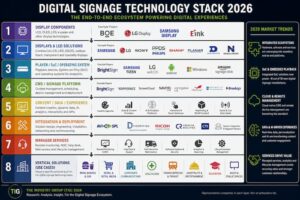
Addendum — Overall Digital Signage Market View
We have feature article on this subject on digital-signage.blog
digital signage stack
About the Editor
Craig Allen Keefner is an industry analyst covering restaurant technology, digital menu boards, self-ordering, drive-thru technology and customer-facing self-service. His work focuses on the technologies, suppliers and deployment strategies shaping modern restaurant operations and the digital customer experience.
Connect with Craig Keefner on LinkedIn for restaurant technology and self-service industry analysis.
Resources
- https://digital-signage.blog/companion-piece-to-ada-kiosk-rule-digital-signage/
- https://digital-signage.blog/canopee-tech-menu-boards/
- https://kioskindustry.org/ada-kiosk-rule/
- https://kioskindustry.org/advanced-kiosks-monolith/